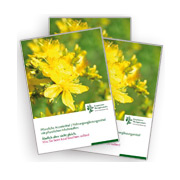
The Green Prescription – a safe medical recommendation
With the Green Prescription, medical doctors have the opportunity to recommend to their patients in writing non-prescription medicines (OTC medicines) that they consider medically useful to take. The Green Prescription therefore also integrates such medicines into an overall medical concept. In addition, the medical doctor’s recommendation is documented on a Green Prescription in the patient file, so that the doctor can keep an eye on his patient’s entire medication.
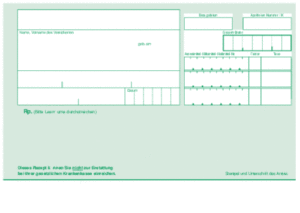 It applies to chemical OTC medicinal products as well as to authorised and traditional herbal medicinal products. Since the German “GKV Modernisation Act” of 2004, all non-prescription medicinal products have been excluded from regular reimbursement by the statutory health insurance companies for cost reasons, with a few exceptions. Excluded are medicinal products for children up to the age of 12 and adolescents with developmental disorders up to the age of 18. In addition, there are exceptions to the exclusion of reimbursement for non-prescription medicinal products that are recognised as standard therapy for certain diseases (Annex I of the German Arzneimittel-Richtlinie, OTC exemption list). From the field of herbal medicinal products, these are psyllium and psyllium husks (for supportive swelling agent treatment in Crohn’s disease, short bowel syndrome and HIV-associated diarrhoea), Ginkgo biloba leaf extract (only for the treatment of dementia) and mistletoe preparations (only in the palliative therapy of malignant tumours to improve quality of life).
In response to this measure, the Green Prescription was developed, which has been a successful model ever since. In 2018, doctors prescribed almost 50 million non-prescription medicines on Green Prescriptions.
Herbal medicinal products are an established part of health care, especially in the field of self-medication, and enjoy a high level of acceptance in Germany. In 2018, 85 percent of herbal medicinal products sold in pharmacies were sold as part of self-medication. ARE THERE ANY MORE RECENT FIGURES? Many statutory health insurance companies have reacted to the positive perception of herbal medicinal products in the population. In the meantime, more than 75 statutory health insurance companies reimburse their insured persons for medically recommended medicinal products up to a defined amount as part of so-called statutory benefits on green prescriptions. This offer mainly concerns prescriptions of herbal as well as homoeopathic and anthroposophic medicinal products. Further information on the statutory benefits and an overview of the OTC services of the individual health insurance companies can be found here.