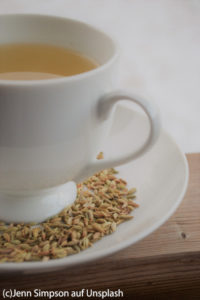
Estragole is a natural component of many plants, such as fennel, anise or basil. Studies on mice and rat liver cells showed that this phenylpropane derivative can have a carcinogenic effect.
On 1 March 2022, the Committee on Herbal Medicinal Products (HMPC) published the update of the Public statement on the use of herbal medicinal products containing estragole, which has been under discussion since 2014 and has been commented on several times by interested parties. Although the HMPC does not derive a generally applicable limit value from the toxicological assessment, also taking into account the intake of estragole through food, it does require that the intake of estragole from herbal medicinal products should generally be as low as possible which includes a short-term duration of use of maximum 14 days.
The guidance value for the maximum intake is 0.05 mg estragole per day. In order to comply with this guideline value or to come as close to it as possible, the lowest dose should be consistently chosen. In addition, low-estragole plant varieties should be used, or an appropriate limitation of the estragole content should be made in the specification of the herbal multi-substance mixture. The use of herbal medicinal products containing estragole in pregnant and breastfeeding women is not recommended if the daily estragole intake exceeds the guidance value of 0.05 mg per day, unless a risk assessment based on adequate safety data justifies otherwise. For children up 11 years of age, a guidance value of 1 μg per kg of body weight is specified under the same conditions.
In addition, the use of excipients containing estragole should be reduced as much as possible. If appropriate excipients are used, the guidance value of 0.05 mg estragole per day for adults and adolescents and 1 μg per kg of body weight per day for children should not be exceeded.
With regard to estragole in fennel tea as a food, the EU Commission has initiated a procedure under Article 8 of Regulation (EC) No. 1925/2006. Under this procedure, restrictions and bans on additives in food can be issued in the EU.
On the basis of these requirements, appropriate regulatory measures will be necessary in the future as well as possibly also the submission of safety reports for the marketing authorisation holders of herbal medicinal products. Therefore, in the years 2022-2024, Kooperation Phytopharmaka together with the TU Kaiserslautern investigated the effect of estragole on human hepatocytes as part of a dissertation. The first results were published in May 2025:
Molecular dosimetry of estragole and 1′-hydroxyestragole-induced DNA adduct formation, clastogenicity and cytotoxicity in human liver cell models
Ackermann G, Fahrer J et al., Archives of Toxicology 2025 May 21 (online).
https://doi.org/10.1007/s00204-025-04084-2